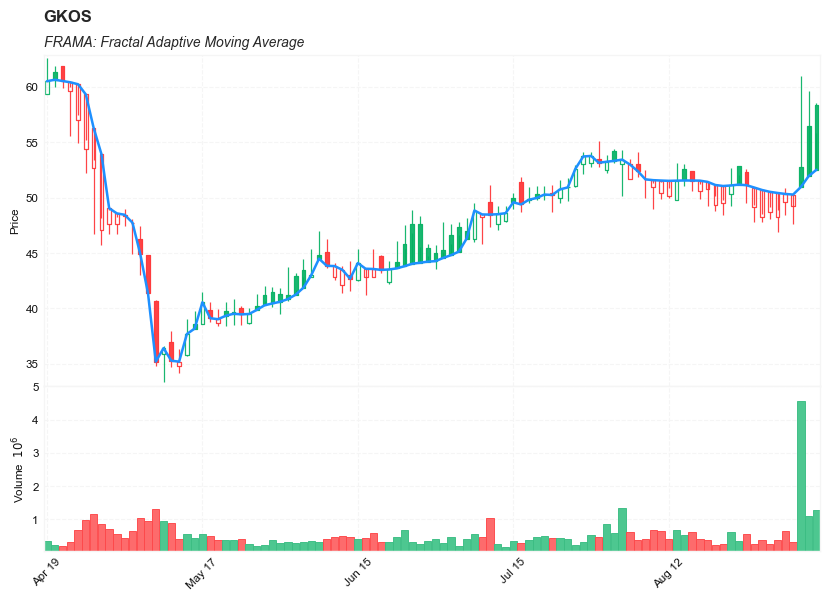
FRAMA: Fractal Adaptive Moving Average
References
- prorealcode: Fractal Adaptive Moving Average
- FRAMA – Fractal Adaptive Moving Average By John Ehlers
- etfhq: Fractal Adaptive Moving Average
Definition
- The Fractal Adaptive Moving Average (FRAMA) was developed by John Ehlers.
- The indicator is constructed on the EMA exponential moving average algorithm, with a smoothing factor calculated on the basis of the current fractal dimension of the price.
- The advantage of the indicator is the ability to track strong trend movements and market consolidation moments.
Read the indicator
The interpretation of the indicator is identical to the interpretation of moving averages
- The FRAMA line is relatively “flat” in periods of horizontal range trading. It could therefore be used to avoid many false signals when it is desired to use a technique of the crossing of moving averages.
- The FRAMA line has a greater reactivity to changes in trends than moving averages, making it possible to take a much earlier position on a breakout of the horizontal channel.
Load basic packages
import pandas as pd
import numpy as np
import os
import gc
import copy
from pathlib import Path
from datetime import datetime, timedelta, time, date
#this package is to download equity price data from yahoo finance
#the source code of this package can be found here: https://github.com/ranaroussi/yfinance/blob/main
import yfinance as yf
pd.options.display.max_rows = 100
pd.options.display.max_columns = 100

import warnings
warnings.filterwarnings("ignore")

import pytorch_lightning as pl
random_seed=1234
pl.seed_everything(random_seed)
Global seed set to 1234


1234
#S&P 500 (^GSPC),  Dow Jones Industrial Average (^DJI), NASDAQ Composite (^IXIC)
#Russell 2000 (^RUT), Crude Oil Nov 21 (CL=F), Gold Dec 21 (GC=F)
#Treasury Yield 10 Years (^TNX)

#benchmark_tickers = ['^GSPC', '^DJI', '^IXIC', '^RUT',  'CL=F', 'GC=F', '^TNX']

benchmark_tickers = ['^GSPC']
tickers = benchmark_tickers + ['GSK', 'NVO', 'AROC', 'GKOS']
#https://github.com/ranaroussi/yfinance/blob/main/yfinance/base.py
#     def history(self, period="1mo", interval="1d",
#                 start=None, end=None, prepost=False, actions=True,
#                 auto_adjust=True, back_adjust=False,
#                 proxy=None, rounding=False, tz=None, timeout=None, **kwargs):

dfs = {}

for ticker in tickers:
    cur_data = yf.Ticker(ticker)
    hist = cur_data.history(period="max", start='2000-01-01')
    print(datetime.now(), ticker, hist.shape, hist.index.min(), hist.index.max())
    dfs[ticker] = hist
2022-09-10 22:19:15.989643 ^GSPC (5710, 7) 1999-12-31 00:00:00 2022-09-09 00:00:00
2022-09-10 22:19:16.349383 GSK (5710, 7) 1999-12-31 00:00:00 2022-09-09 00:00:00
2022-09-10 22:19:16.721121 NVO (5710, 7) 1999-12-31 00:00:00 2022-09-09 00:00:00
2022-09-10 22:19:16.968170 AROC (3791, 7) 2007-08-21 00:00:00 2022-09-09 00:00:00
2022-09-10 22:19:17.186939 GKOS (1816, 7) 2015-06-25 00:00:00 2022-09-09 00:00:00
ticker = 'GKOS'
dfs[ticker].tail(5)
| Open | High | Low | Close | Volume | Dividends | Stock Splits | |
|---|---|---|---|---|---|---|---|
| Date | |||||||
| 2022-09-02 | 49.590000 | 50.900002 | 48.419998 | 48.830002 | 650900 | 0 | 0 |
| 2022-09-06 | 49.200001 | 49.200001 | 47.630001 | 48.099998 | 334400 | 0 | 0 |
| 2022-09-07 | 52.759998 | 60.919998 | 51.490002 | 57.009998 | 4560500 | 0 | 0 |
| 2022-09-08 | 56.439999 | 59.599998 | 56.439999 | 58.380001 | 1106900 | 0 | 0 |
| 2022-09-09 | 58.369999 | 58.529999 | 55.860001 | 56.299999 | 1291100 | 0 | 0 |
Define FRAMA calculation function
#https://github.com/peerchemist/finta/blob/master/finta/finta.py
def cal_frama(series: pd.Series, period: int = 16, batch: int=10) -> pd.Series:
        """Fractal Adaptive Moving Average
        :period: Specifies the number of periods used for FRANA calculation
        :batch: Specifies the size of batches used for FRAMA calculation
        """

        assert period % 2 == 0, print("FRAMA period must be even")

        window = batch * 2

        hh = series.rolling(batch).max()
        ll = series.rolling(batch).min()

        n1 = (hh - ll) / batch
        n2 = n1.shift(batch)

        hh2 = series.rolling(window).max()
        ll2 = series.rolling(window).min()
        n3 = (hh2 - ll2) / window

        # calculate fractal dimension
        D = (np.log(n1 + n2) - np.log(n3)) / np.log(2)
        alp = np.exp(-4.6 * (D - 1))
        alp = np.clip(alp, .01, 1).values

        filt = series.values
        for i, x in enumerate(alp):
            cl = series.values[i]
            if i < window:
                continue
            filt[i] = cl * x + (1 - x) * filt[i - 1]

        return pd.Series(filt, index=series.index, name=f"FRAMA{period}")
Calculate FRAMA
df = dfs[ticker][['Open', 'High', 'Low', 'Close', 'Volume']]
df = df.round(2)
df_ta = cal_frama(df['Close'], period = 16, batch = 10)
df = df.merge(df_ta, left_index = True, right_index = True, how='inner' )

del df_ta
gc.collect()
80
display(df.head(5))
display(df.tail(5))
| Open | High | Low | Close | Volume | FRAMA16 | |
|---|---|---|---|---|---|---|
| Date | ||||||
| 2015-06-25 | 29.11 | 31.95 | 28.00 | 31.22 | 7554700 | 31.22 |
| 2015-06-26 | 30.39 | 30.39 | 27.51 | 28.00 | 1116500 | 28.00 |
| 2015-06-29 | 27.70 | 28.48 | 27.51 | 28.00 | 386900 | 28.00 |
| 2015-06-30 | 27.39 | 29.89 | 27.39 | 28.98 | 223900 | 28.98 |
| 2015-07-01 | 28.83 | 29.00 | 27.87 | 28.00 | 150000 | 28.00 |
| Open | High | Low | Close | Volume | FRAMA16 | |
|---|---|---|---|---|---|---|
| Date | ||||||
| 2022-09-02 | 49.59 | 50.90 | 48.42 | 50.322998 | 650900 | 50.322998 |
| 2022-09-06 | 49.20 | 49.20 | 47.63 | 50.267480 | 334400 | 50.267480 |
| 2022-09-07 | 52.76 | 60.92 | 51.49 | 50.951297 | 4560500 | 50.951297 |
| 2022-09-08 | 56.44 | 59.60 | 56.44 | 51.928922 | 1106900 | 51.928922 |
| 2022-09-09 | 58.37 | 58.53 | 55.86 | 52.504161 | 1291100 | 52.504161 |
#https://github.com/matplotlib/mplfinance
#this package help visualize financial data
import mplfinance as mpf
import matplotlib.colors as mcolors

# all_colors = list(mcolors.CSS4_COLORS.keys())#"CSS Colors"
all_colors = list(mcolors.TABLEAU_COLORS.keys()) # "Tableau Palette",
# all_colors = list(mcolors.BASE_COLORS.keys()) #"Base Colors",


#https://github.com/matplotlib/mplfinance/issues/181#issuecomment-667252575
#list of colors: https://matplotlib.org/stable/gallery/color/named_colors.html
#https://github.com/matplotlib/mplfinance/blob/master/examples/styles.ipynb

def plot_3panels(main_data, add_data=None, mid_panel=None, chart_type='candle', names=None,
                  figratio=(14,9)):


    style = mpf.make_mpf_style(base_mpf_style='yahoo',  #charles
                               base_mpl_style = 'seaborn-whitegrid',
#                                marketcolors=mpf.make_marketcolors(up="r", down="#0000CC",inherit=True),
                               gridcolor="whitesmoke",
                               gridstyle="--", #or None, or - for solid
                               gridaxis="both",
                               edgecolor = 'whitesmoke',
                               facecolor = 'white', #background color within the graph edge
                               figcolor = 'white', #background color outside of the graph edge
                               y_on_right = False,
                               rc =  {'legend.fontsize': 'small',#or number
                                      #'figure.figsize': (14, 9),
                                     'axes.labelsize': 'small',
                                     'axes.titlesize':'small',
                                     'xtick.labelsize':'small',#'x-small', 'small','medium','large'
                                     'ytick.labelsize':'small'
                                     },
                              )

    if (chart_type is None) or (chart_type not in ['ohlc', 'line', 'candle', 'hollow_and_filled']):
        chart_type = 'candle'
    len_dict = {'candle':2, 'ohlc':3, 'line':1, 'hollow_and_filled':2}

    kwargs = dict(type=chart_type, figratio=figratio, volume=True, volume_panel=1,
                  panel_ratios=(4,2), tight_layout=True, style=style, returnfig=True)

    if names is None:
        names = {'main_title': '', 'sub_tile': ''}


    added_plots = {

        'FRAMA16': mpf.make_addplot(add_data['FRAMA16'], panel=0, color='dodgerblue', secondary_y=False),
#         'AO-SIGNAL': mpf.make_addplot(mid_panel['AO']-mid_panel['SIGNAL'], type='bar',width=0.7,panel=1, color="pink",alpha=0.65,secondary_y=False),
    }


    fig, axes = mpf.plot(main_data,  **kwargs,
                         addplot=list(added_plots.values()),
                        )
    # add a new suptitle
    fig.suptitle(names['main_title'], y=1.05, fontsize=12, x=0.135)

    axes[0].set_title(names['sub_tile'], fontsize=10, style='italic',  loc='left')


    #set legend

#     axes[0].legend([None]*6)
#     handles = axes[0].get_legend().legendHandles
#     print(handles)
#     axes[0].legend(handles=handles[4:],labels=['MAMA', 'FAMA'])
    #axes[2].set_title('AO', fontsize=10, style='italic',  loc='left')
#     axes[0].set_ylabel('MAMA')


#     axes[0].set_ylabel(names['y_tiles'][0])
    return fig, axes
start = -100
end = df.shape[0]

names = {'main_title': f'{ticker}',
         'sub_tile': 'FRAMA: Fractal Adaptive Moving Average'}


aa_, bb_ = plot_3panels(df.iloc[start:end][['Open', 'High', 'Low', 'Close', 'Volume']],
             df.iloc[start:end][[ 'FRAMA16']],
             None,
             chart_type='hollow_and_filled',
                     names = names,
                    )