Anomaly Detection: Isolation Forest, VAE, Ensemble
Applies Salesforce Merlion to generate anomaly scores on a market-derived time series using three unsupervised detectors:
- Isolation Forest
- VAE (Variational Autoencoder)
- Ensemble (Isolation Forest + VAE via
DetectorEnsemble)
The goal is not labeled anomaly detection; instead, this analysis test whether anomaly scores carry information about forward upside potential.
Data & target
- Data source:
yfinance - Asset: S&P 500 (
^GSPC) - Start date:
2000-01-01 - Test split: last
400observations
Forward 20-day max return target
For each date \(t\) with close \(C_t\):
\[target_t = 100 \times \frac{\max(C_{t+1}, \dots, C_{t+20}) - C_t}{C_t}\]Implementation detail: the max is computed over \([t+1, t+20]\) (starting tomorrow) to avoid look-ahead leakage.
Method
Models (Merlion)
IsolationForest(IsolationForestConfig())VAE(VAEConfig())DetectorEnsemble(...)over both detectors, usingAggregateAlarms(alm_threshold=4)
Training & scoring
- Train on the target series as a univariate
TimeSeries(no anomaly labels). - Training anomaly scores are produced during
.train(...). - Test anomaly scores are produced via
.get_anomaly_score(test_data).
Evaluation (post-hoc)
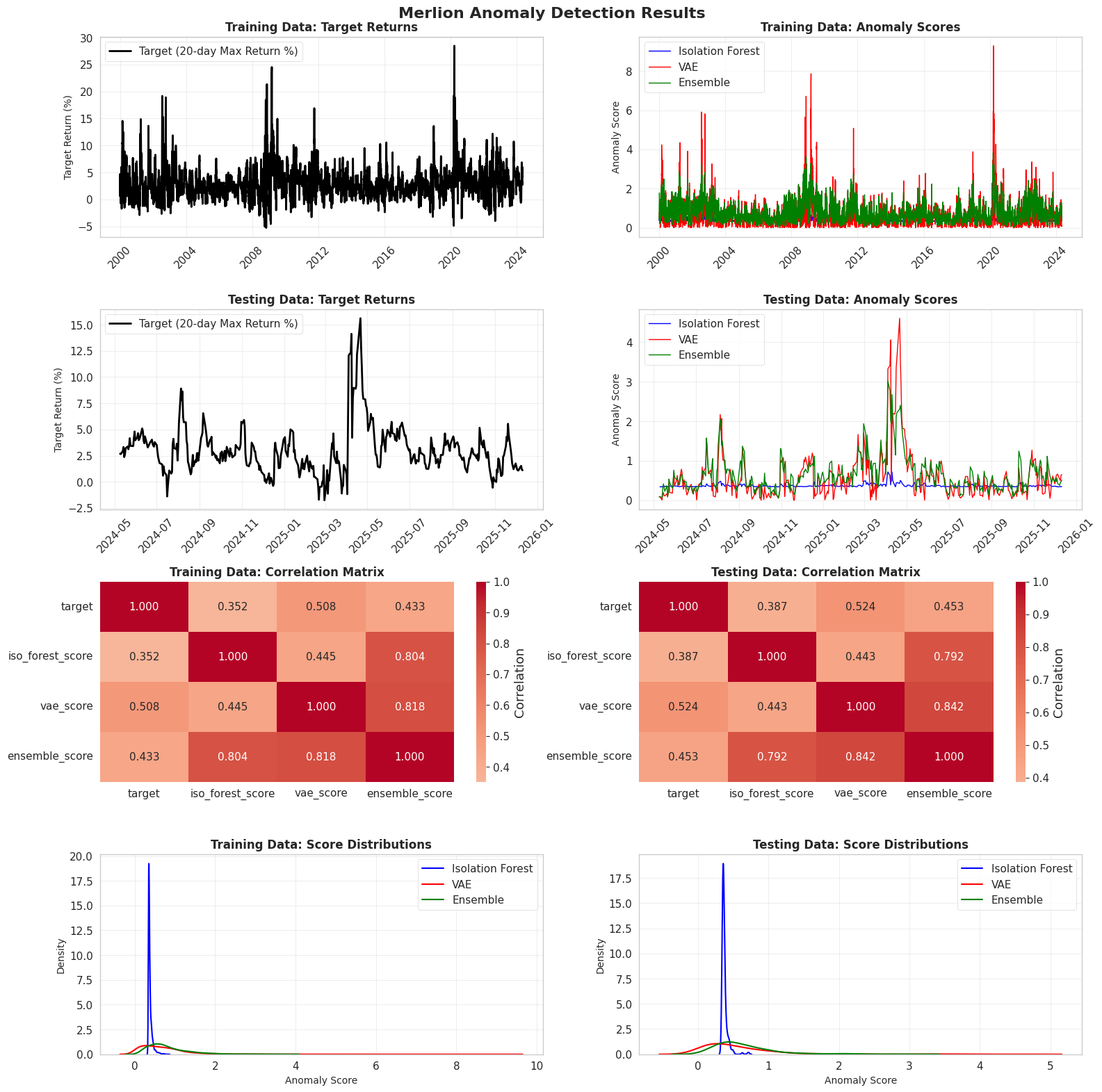
This notebook treats the anomaly score as a candidate signal and reports:
- Correlation between \(target_t\) and each anomaly score on train
- Correlation on test
- Train → test correlation drop as a rough generalization check
Visual outputs
- Time series overlays (target vs anomaly scores) for train and test
- Correlation heatmaps (train/test)
- Score distribution comparisons (train/test)
Key takeaways
- VAE is the strongest single model in this run: it shows the highest correlation with the forward \(20\)-day max return target on both the training and testing splits (relative to Isolation Forest and the ensemble).
- Scale matters when comparing anomaly scores: VAE produces consistently larger-magnitude anomaly scores than the other methods. This likely reflects different score calibration/normalization across detectors rather than “more anomalies” in an absolute sense.
- Practical implication: if you want a single unsupervised score that best tracks the forward-move proxy used here, VAE is the best candidate from these three. For downstream use, consider standardizing scores (e.g., z-score by a rolling window) before thresholding or combining with other signals.
References
- Merlion: https://github.com/salesforce/Merlion
- Merlion example: https://github.com/salesforce/Merlion/blob/main/examples/anomaly/1_AnomalyFeatures.ipynb
- Isolation Forest (sklearn): https://scikit-learn.org/stable/modules/generated/sklearn.ensemble.IsolationForest.html
- Merlion VAE implementation: https://github.com/salesforce/Merlion/blob/main/merlion/models/anomaly/vae.py